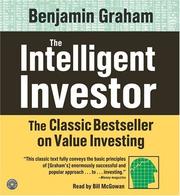
Books Like The Intelligent Investor
by Benjamin Graham
The Intelligent Investor is a practical manual of value investing built around two simple but potent mechanics: focus on intrinsic value and insist on a margin of safety. Benjamin Graham organizes the book as a series of investor rules and thought experiments — from the defensive vs. enterprising investor distinction to concrete techniques for assessing balance sheets, earnings and market temperament — all aimed at minimizing permanent loss of capital rather than chasing short-term gains.
Readers come to The Intelligent Investor for different reasons: to learn Graham’s conservative valuation framework, to absorb his behavioral warnings about market euphoria, or to adopt a disciplined allocation and rebalancing posture. The nine books below were chosen to match those specific hooks — from Graham’s own technical companion to modern arguments for indexing, complementary qualitative approaches to picking businesses, and investor-letters that translate value principles into corporate and portfolio practice.
Recommended for fans of The Intelligent Investor
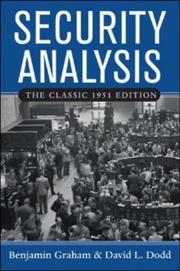
Security Analysis
Benjamin Graham and David Dodd
The deep, rigorous foundation behind value investing and intrinsic value analysis.
Pick this if you want the deep, accounting-level backbone behind Graham’s rules. Security Analysis is the original, exhaustive treatment of how to calculate intrinsic value and dissect financial statements — denser and more technical than The Intelligent Investor.
The Essays of Warren Buffett
Lawrence A. Cunningham
Curated Buffett letters distilling corporate governance, valuation, and shareholder focus.
Pick this if you want to see value principles applied in corporate decision-making and shareholder letters. The Essays of Warren Buffett curate Buffett’s commentary on governance, valuation and capital allocation as an investor’s guide built on Graham’s foundation.
Margin of Safety
Seth Klarman
A modern value-investing manifesto emphasizing risk aversion and margin preservation.
Pick this if you want a contemporary, practitioner-level restatement of Graham’s central idea. Margin of Safety applies the same capital-preservation ethos to later-market environments and is close in spirit to Graham’s priorities.
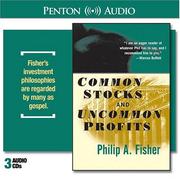
Common Stocks and Uncommon Profits
Philip A. Fisher
Qualitative company analysis and the scuttlebutt approach complement Graham's methods.
Pick this if you wish to add management and growth-quality analysis to Graham’s numerical framework. Fisher’s approach complements Graham by teaching how to evaluate leadership, competitive edge and long-term business prospects.

The Most Important Thing
Howard Marks
Disciplined risk assessment and market cycles, with sharp memos on investor thinking.
Pick this if you appreciated Graham’s focus on temperament and want sharper memos on risk assessment and cyclical thinking. The Most Important Thing translates that behavioral discipline into modern market commentary.

One Up On Wall Street
Peter Lynch
Practical, accessible stock-picking advice emphasizing individual investor advantages.
Pick this if you liked the practical, readable tone and want hands-on stock-picking techniques tailored to ordinary investors. One Up On Wall Street is more tactical and less conservative than Graham but aligns on searching for business advantages.

Stocks for the Long Run
Jeremy J. Siegel
Historical perspective on equities’ long-term returns and economic drivers.
Pick this if you’re interested in historical evidence on equities’ returns and the economic drivers behind them. Stocks for the Long Run supplies the longer-term market context that can inform a Graham-style allocation choice.
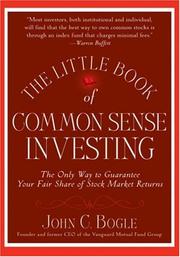
The Little Book of Common Sense Investing
John C. Bogle
Clear, practical case for low-cost index investing as a long-term strategy.
Pick this if you favor a low-cost, long-horizon alternative to stock selection. Bogle’s book makes the practical case for index funds as a defensive implementation of many of Graham’s investor protections.
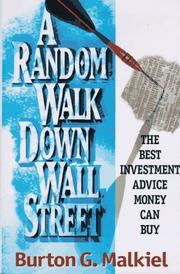
A Random Walk Down Wall Street
Burton G. Malkiel
Contrasts active value strategies with efficient-market and indexing perspectives.
Pick this if you want a clear counterpoint to active value strategies. A Random Walk Down Wall Street argues the efficient-market and indexing case; it’s a philosophical and practical foil rather than an extension of Graham’s methods.
At a glance
Matches were chosen on three dimensions central to Graham: rigorous valuation and margin-of-safety thinking, disciplined investor behavior and long-term allocation strategy. Each pick aligns with one or more of those dimensions rather than with genre alone.
| Book | First published | Pages | Closest match on | Match |
|---|---|---|---|---|
Security Analysis Benjamin Graham and David Dodd | 1962 | 766 | Technical valuation foundation | 96% |
The Essays of Warren Buffett Lawrence A. Cunningham | 1997 | 291 | Applied corporate & shareholder focus | 92% |
Margin of Safety Seth Klarman | 1991 | 249 | Modern margin-of-safety doctrine | 90% |
Common Stocks and Uncommon Profits Philip A. Fisher | 2000 | 4 | Qualitative company insight | 88% |
The Most Important Thing Howard Marks | 2011 | 180 | Risk and market cycles | 85% |
One Up On Wall Street Peter Lynch | 1989 | 318 | Individual investor tactics | 82% |
Stocks for the Long Run Jeremy J. Siegel | 1994 | 384 | Long-term equity returns | 80% |
The Little Book of Common Sense Investing John C. Bogle | 2007 | 228 | Indexing, cost discipline | 78% |
A Random Walk Down Wall Street Burton G. Malkiel | 1973 | 440 | Contrast with market efficiency | 75% |
About The Intelligent Investor
First published in 1949, The Intelligent Investor established Benjamin Graham’s philosophy of value investing and introduced cornerstone concepts such as ‘margin of safety’ and the defensive vs. enterprising investor. Graham’s ideas shaped generations of investors and influenced notable practitioners who cited the book as foundational to their approach.
Frequently asked questions
Should I read Security Analysis or The Intelligent Investor first?+
If you want the theoretical and accounting depth underlying Graham’s approach, start with Security Analysis (coauthored with David Dodd). If you prefer a practical, investor-facing primer on application and behavior, The Intelligent Investor is the better entry point.
How do these books relate to passive investing?+
The Little Book of Common Sense Investing presents a clear, practical case for low-cost index funds as a long-term strategy, which is a logical defensive complement to Graham’s advice for investors who prefer minimal stock-picking effort.
Which book expands on qualitative company research?+
Common Stocks and Uncommon Profits offers Philip Fisher’s qualitative, scuttlebutt-style analysis of management quality and competitive advantage — a complementary lens to Graham’s hard-number focus.
Are there modern equivalents to Graham’s margin-of-safety principle?+
Yes. Margin of Safety by Seth Klarman is a contemporary, practitioner-level manifesto that applies the same risk-averse, capital-preservation mindset Graham advocated, though with modern market context and updated examples.
Want recommendations based on your own favorites?
BookTwin can match you to books by mood, pacing, themes, and emotional payoff — based on 1 to 5 books you tell it you loved.
Try BookTwin