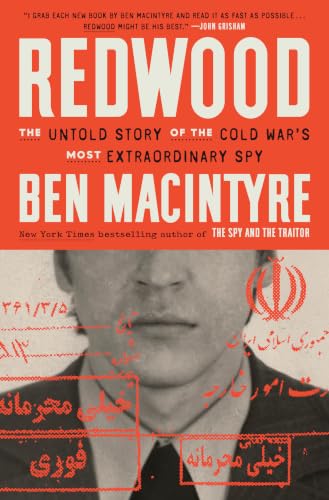
Books Like Redwood
by Ben Macintyre
Redwood is a tightly reported piece of Cold War spy history that rests on two concrete engines: a single extraordinary human source and newly available testimony from the intelligence services that opposed and handled him. Ben Macintyre traces KGB Major Vladimir Kuzichkin — codename “Redwood” — as a serving officer in Iran in 1981 who ran Soviet operations after the Islamic Revolution, then decided to become a double agent. The book reconstructs tradecraft, clandestine handoffs and institutional back-and-forth with MI6, MI5 and the CIA, while always carrying the suspense of whether a single defection will expose a wider Kremlin plot and prevent catastrophe.
If you read Redwood for its access to fresh archival material and direct interviews, you’ll want more books that marry meticulous sourcing to cinematic narrative. If you loved the human-scale portrait — the psychology of betrayal, the stresses of running agents in hostile places — or if you were drawn to the operational detail (dead drops, surveillance, counter-surveillance), there are different follow-ups in this list: some emphasize the mole hunt and institutional failure, some excavate individual operatives’ inner lives, and a few lean into the tradecraft and Kremlin-wide implications. Each pick below notes which of those qualities it most closely shares with Redwood.
Recommended for fans of Redwood
The Spy and the Traitor
Ben Macintyre
A gripping Cold War account of KGB officer Oleg Gordievsky’s secret work for British intelligence.
Pick this if you want another Macintyre study of a single high‑value source whose betrayal altered Cold War strategy; this is the closest tonal and methodological match.
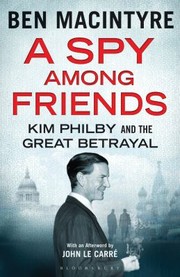
A Spy Among Friends
Ben Macintyre
Reconstructs Kim Philby’s betrayal through intimate relationships, institutional blindness, and high-stakes British intelligence history.
Pick this if you were drawn to the psychology of double agents and institutional blindness. Read this for an intimate reconstruction of trust and treachery within British intelligence.
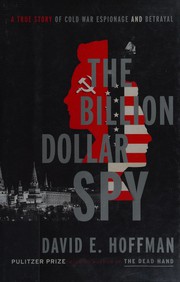
The Billion Dollar Spy
David E. Hoffman
Tells the tense true story of a Soviet engineer who supplied transformative military intelligence to the CIA.
Pick this if you appreciated how Kuzichkin’s documents changed policy. This book similarly shows how one human asset supplied intelligence that had outsized strategic consequences.

The Moscow Rules
Antonio J. Mendez and Jonna Mendez
Reveals ingenious CIA tradecraft used to operate against relentless KGB surveillance inside Moscow.
Pick this if it was the nuts‑and‑bolts of operating under hostile surveillance that interested you; this book lays out improvised CIA techniques used inside Moscow.
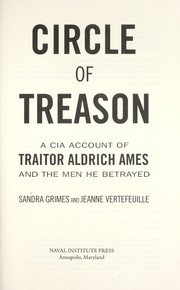
Circle of Treason
Sandra Grimes and Jeanne Vertefeuille
Two CIA veterans recount the painstaking hunt for Soviet mole Aldrich Ames from inside the investigation.
Pick this if you want a painstaking, institutional account of how a Western agency detected and pursued a mole from within; it shares Redwood’s focus on internal procedures and consequences.
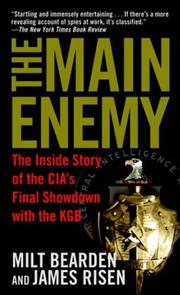
The Main Enemy
Milt Bearden and James Risen
A panoramic, insider-driven history of the CIA and KGB’s clandestine struggle during the Cold War.
Pick this if you’re curious about the broader CIA–KGB struggle that makes a single defection consequential; expect wide sweep and insider perspective rather than a lone human drama.
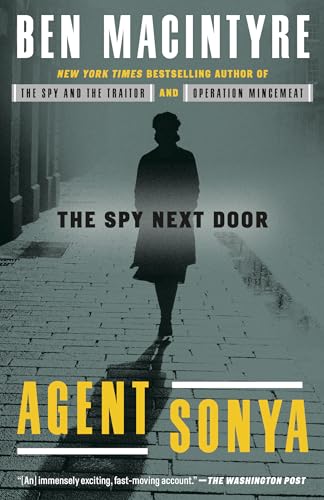
Agent Sonya
Ben Macintyre
Follows a remarkable Soviet operative through ideological commitment, dangerous missions, deception, and personal sacrifice.
Pick this if you liked Macintyre’s sympathetic, granular portraits of individual operatives. This follows a Soviet agent’s ideological commitment and personal sacrifices in the same biographical register.
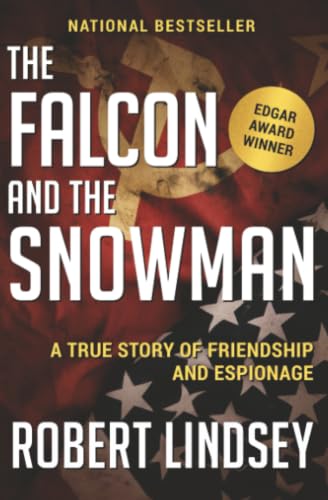
The Falcon and the Snowman
Robert Lindsey
Chronicles two young Americans who sold secrets to Moscow, combining psychological depth with escalating suspense.
Pick this if you were fascinated by motivation and moral unraveling; this account of Americans who betrayed secrets to Moscow emphasizes psychological complexity and incremental escalation.

The Sword and the Shield
Christopher Andrew and Vasili Mitrokhin
Uses a KGB archivist’s smuggled records to expose Soviet operations, agents, and strategic ambitions across the West.
Pick this if you want the widest possible documentary sweep on KGB operations. This relies on an archive source to expose Soviet networks, complementing Redwood’s interview‑driven reconstruction.
At a glance
Matches were chosen for three concrete dimensions emphasized in Redwood: (1) first‑person sourcing and newly available material, (2) close operational tradecraft and the mechanics of running agents, and (3) institutional history — how Western services and Soviet structures reacted. Each recommendation shares some but not necessarily all of those elements; the percentage reflects the overall overlap.
| Book | First published | Pages | Closest match on | Match |
|---|---|---|---|---|
The Spy and the Traitor Ben Macintyre | 2018 | 384 | Single‑source mole portrait | 98% |
A Spy Among Friends Ben Macintyre | 2014 | 384 | Betrayal inside intelligence | 96% |
The Billion Dollar Spy David E. Hoffman | 2016 | 312 | Value of one source | 95% |
The Moscow Rules Antonio J. Mendez and Jonna Mendez | 2019 | 272 | Tradecraft under surveillance | 93% |
Circle of Treason Sandra Grimes and Jeanne Vertefeuille | 2012 | 234 | Mole‑hunt from inside | 91% |
The Main Enemy Milt Bearden and James Risen | 2004 | 576 | Panoramic Cold War context | 90% |
Agent Sonya Ben Macintyre | 2020 | 432 | Operative’s inner life | 89% |
The Falcon and the Snowman Robert Lindsey | 1979 | 383 | Western citizens who sold secrets | 87% |
The Sword and the Shield Christopher Andrew and Vasili Mitrokhin | 1999 | 700 | Kremlin archive revelations | 86% |
About Redwood
Redwood (2026) is a nonfiction espionage history by Ben Macintyre subtitled The Untold Story of the Cold War's Most Extraordinary Spy. It centers on KGB Major Vladimir Kuzichkin (codename Redwood), who ran Soviet intelligence in Iran in 1981, later became a double agent, and whose information exposed a Kremlin plot and contributed to averting catastrophe. The narrative draws on new material and interviews with MI6, MI5, KGB and CIA officers.
Frequently asked questions
How does Redwood differ from Ben Macintyre’s earlier books?+
Redwood shares Macintyre’s narrative nonfiction style and use of office‑level testimony, but its focus is a single KGB officer in Iran in 1981 and the new archival and interview material that illuminate his double life. If you liked Macintyre’s blend of biography and espionage in The Spy and the Traitor or Agent Sonya, Redwood continues that method with a different geography and a Cold War flashpoint.
Is Redwood based on newly available sources?+
Yes. The book explicitly relies on recently obtained material and interviews with MI6, MI5, KGB and CIA officers, which Macintyre uses to reconstruct both operational details and institutional responses to Kuzichkin’s defection.
Should I read other nonfiction about mole hunts and betrayals?+
Yes. A Spy Among Friends and The Spy and the Traitor are natural next reads for readers who want other close reconstructions of betrayals inside Western intelligence; Circle of Treason focuses on an internal CIA mole investigation, and The Billion Dollar Spy examines the intelligence value of a single human source.
Is Redwood like a spy novel?+
No. Redwood is strictly nonfiction and works as reporting and history rather than fiction. If you want thriller pacing paired with factual reconstruction, Macintyre’s other works on real espionage (The Spy and the Traitor, A Spy Among Friends, Agent Sonya) offer the closest experience.
Want recommendations based on your own favorites?
BookTwin can match you to books by mood, pacing, themes, and emotional payoff — based on 1 to 5 books you tell it you loved.
Try BookTwin